Among the various important elements of the Swoyambhu Mahachaitya, which is listed as a UNESCO World Heritage Site, the Five Buddhas (Panchabuddha) are considered principal. It is described in various chronicles that after the origin of the Swoyambhu Mahachaitya, the Five Buddhas manifested. The Five Buddhas refer to five types of primordial Buddhas. These Five Buddhas are:
(a) Vairochana
(b) Akshobhya
(c) Amitabha
(d) Ratnasambhava
(e) Amoghasiddhi
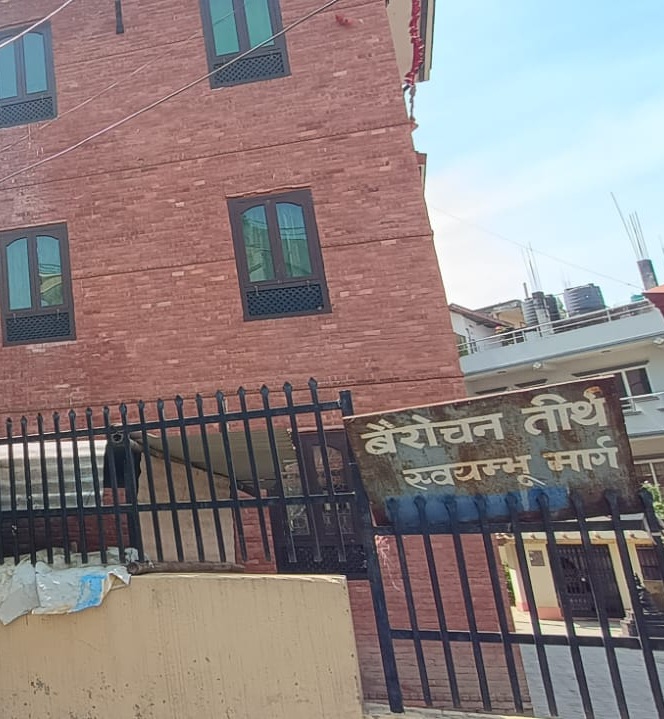
Among these five primordial Buddhas, the sacred site (tirtha) of Vairocana Buddha is located in the central area of Kathmandu Metropolitan City Ward No. 15, on the main road from Bijeshwori Temple to Swoyambhu.
In Vajrayana and Mahayana Buddhism, Vairocana Tathagata is regarded as one of the principal Buddhas. He is often compared with the sun, as both provide impartial light to all living beings. However, unlike the sun—whose light can be obstructed and which disappears at night—the light of Vairocana Buddha is universal, cannot be obstructed, and eternally shines. For this reason, Vairocana Buddha is also called the “Great Sun.”
The origin of Vairocana Buddha is associated with the emergence of the sacred pond (tirtha). Around the Swoyambhu Mahachaitya, there are mainly twelve sacred ponds, and five ponds related to the Five Buddhas are also located within the Swayambhu area. Among these sacred sites, the Vairocana Tirtha is considered very important. Once a simple pond, it is believed to have been protected by five Nagas (serpent deities), as witnessed by pedestrians traveling in that area.
Special worship is performed every year during the Gunla month at this sacred pond and temple. It is mentioned in a historical stone inscription that this area has been protected by Bajracharya priests since its origin. Even today, Bajracharya priests continue to conserve and develop this site.
As part of its preservation, the Bajracharya priests constructed a small Buddha monastery/temple for worship. Since Vairocana Buddha is equally respected by followers of both Mahayana and Vajrayana Buddhism, about five decades ago, the renowned Vajrayana master Padmabajra Bajracharya installed Guru Rinpoche Jagat Prakash in the temple located on the southern side of the pond. This site is now reconstructed and known as Jagatprakash Gumba.
The monastery was completely damaged by the devastating earthquake of 2015 (B.S. 2072). It was reconstructed through the efforts of the Vairochana Tirtha Conservation Committee, Kathmandu Metropolitan City, and public support. Currently, monasteries and gumba belonging to both Mahayana and Vajrayana traditions are built in this historically and spiritually significant area under Ward No. 15 of Kathmandu Metropolitan City, and regular rituals and worship are being conducted. The sacred pond has also been developed into a beautiful place of worship.
-Sagar Man Bajracharya
https://maps.app.goo.gl/w6Q4fXJu5Xe35YRQ9