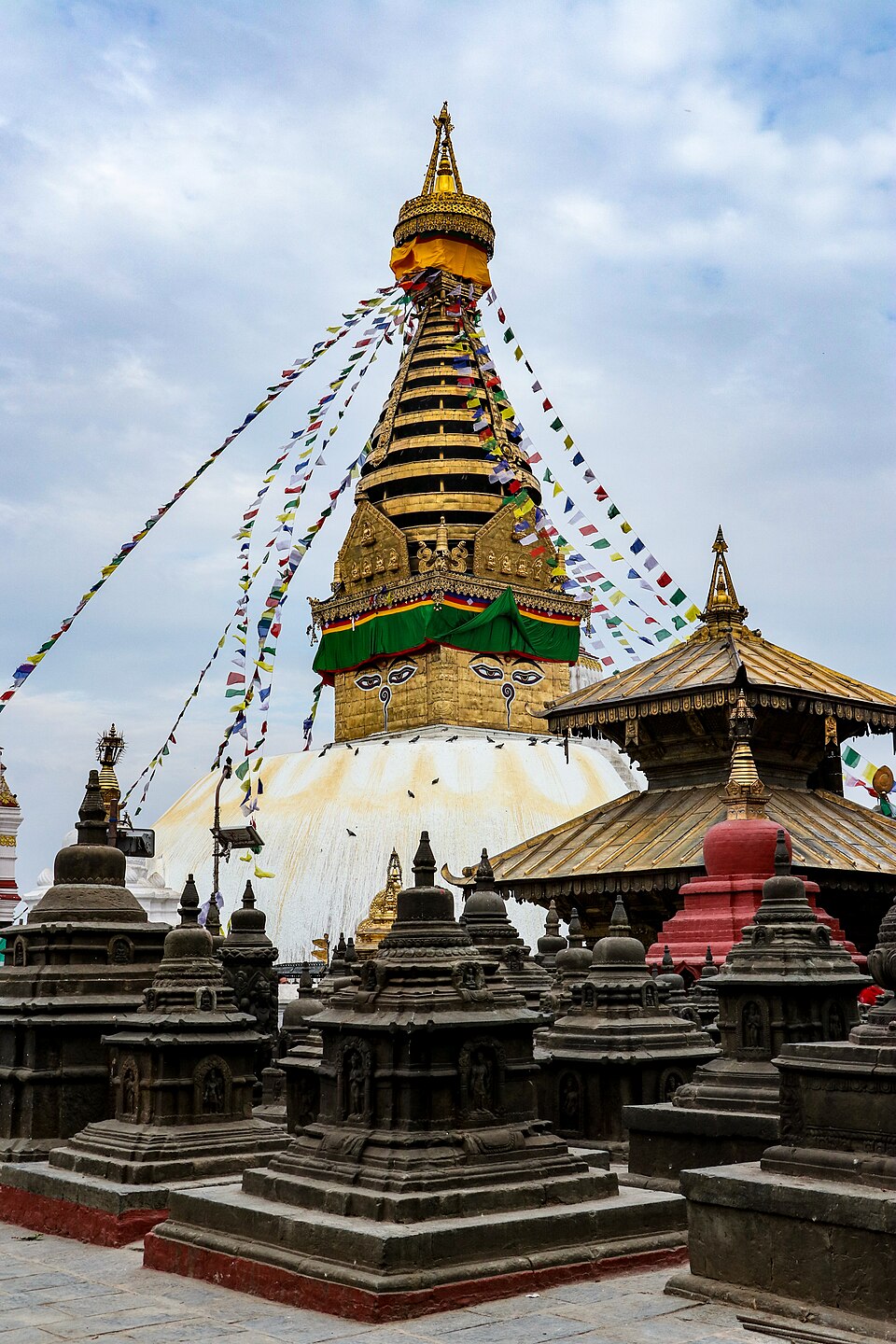
In ancient times, the Kathmandu Valley was a vast lake filled with water. It is believed that the Swoyambhu Mahachaitya self-originated in this lake. The water of the lake was drained by Manjushri, the Bodhisattva, who cut open a path in four directions (Foo-chwo, Dhila-chwo, Jama-chwo and Sipoo-chawo) to establish settlements and appointed a man named Prachanda Dev as the king. The king protected the Swoyambhu Mahachaitya by constructing it in the shape of a hemispherical white dome (stupa), symbolising the world or the universe.
Inside the womb of the stupa, the Pancha Buddha (symbolising the five elements or Pancha-tatwo) and the chaturmahabhuta (symbolising the four great elements) are enshrined. Above this, the eyes of the Buddha represent wisdom and skilful means, while the question-mark-like symbol signifies the liberation of all living beings. The forehead mark (Tika) symbolises the radiant energy that illuminates the three realms (Triloka). The Trayodash Bhuvan is considered as the steps towards attaining Buddhahood.
It is also said that in ancient times, the area around Goshringa Parvat (mountain) was known as Singu or Syangu, which eventually became Swoyambhu. The Swoyambhu Mahachaitya is regarded as the oldest chaitya among all the Buddhist chaityas in the Kathmandu Valley.